
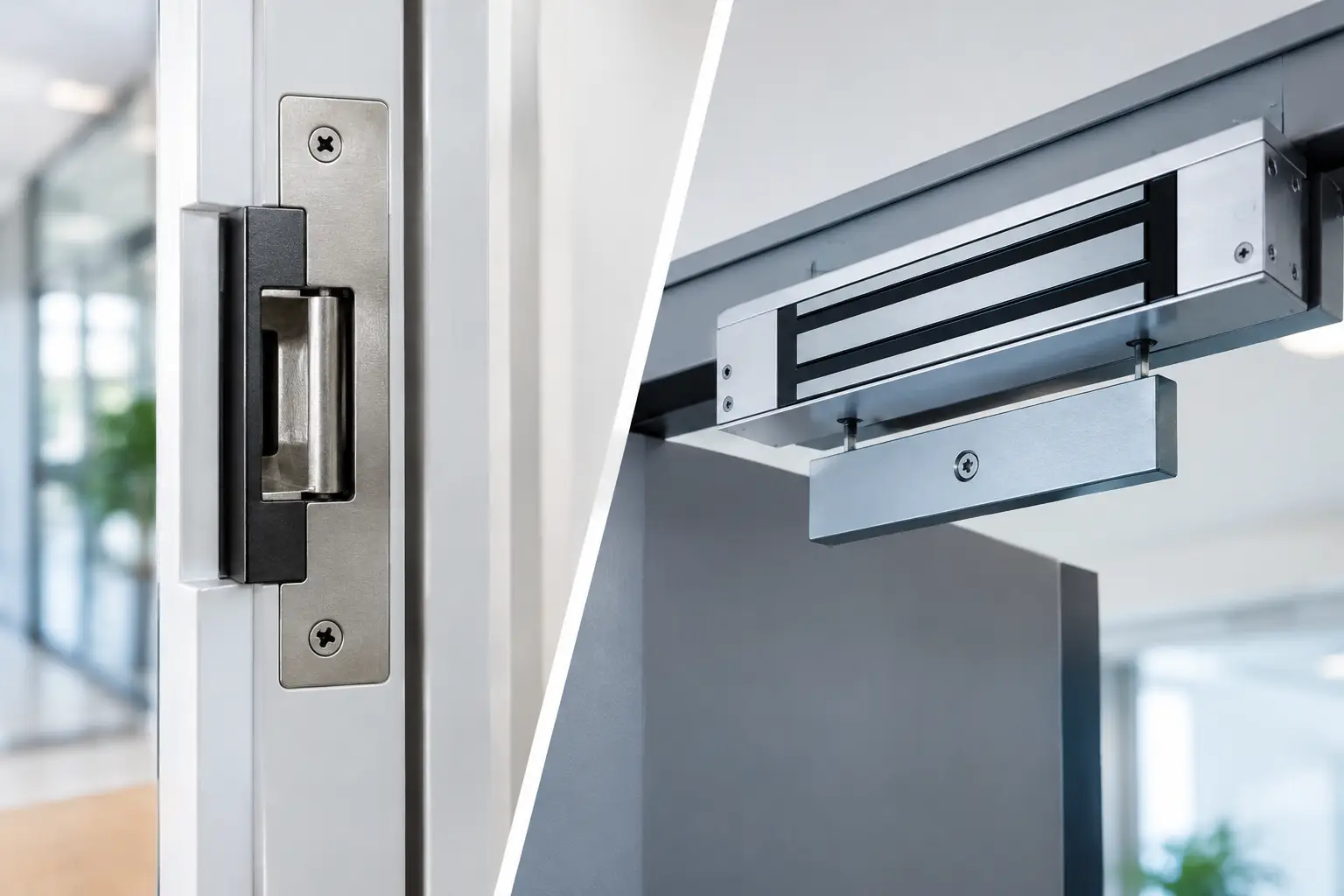
A door that stays locked when it should release can stop a business cold. A door that releases when it should stay secured can create a far more serious problem. When comparing electronic strikes versus maglocks, the best answer comes down to the door, the building’s life-safety requirements, daily traffic, and what should happen during a power outage.
Both options can work with keypads, card readers, intercoms, buzzer systems, and managed access control. They do not, however, secure a door in the same way. Choosing based on price or appearance alone can lead to unreliable operation, difficult exits, or costly rework after installation.
How Electronic Strikes Work
An electronic strike replaces the fixed strike plate in the door frame. Instead of a solid opening that holds the latch, it has an electrically controlled keeper. When an authorized user presents a credential or presses a release button, the keeper moves and allows the latch to pass. The door can then be opened without turning a key from the outside.
The important detail is that an electric strike works with a mechanical latch or lockset. When the door closes, the latch still engages the strike and holds the door shut. This makes strikes a natural fit for many commercial storefronts, office suites, apartment common doors, and exterior doors that already use cylindrical locks, mortise locks, or panic hardware with a latch.
Electric strikes are commonly available in two operating styles. A fail-secure strike stays locked during a power loss and requires a key or other mechanical means of entry. A fail-safe strike releases during a power loss. The correct choice depends on the opening, occupancy, fire and life-safety requirements, and the authority having jurisdiction.
For a property manager, the practical benefit is familiar operation. Staff can still use the door normally from the inside, while access credentials control entry from the exterior. If the access-control system has an issue, a properly planned mechanical override can prevent a total access failure.
Where electric strikes are a strong fit
Electric strikes tend to perform well on single swing doors with a compatible latch, particularly where the owner wants security without changing the look of the door. They are often a good choice for metal or wood doors, framed glass storefront doors with suitable hardware, and doors that need a conventional locked-door feel.
They also use power only when changing state in many configurations, rather than requiring continuous power to hold the door locked. That can simplify backup-power planning, though every access-control system should still be designed around the building’s security and emergency needs.
Installation is not always simple. The frame must be prepared accurately, the latch must align correctly, and the existing lock hardware must be compatible. A sagging door, misaligned closer, damaged latch, or loose hinges can make even a high-quality strike perform poorly.
How Maglocks Work
A magnetic lock, commonly called a maglock, uses an electromagnet mounted at the top of the frame and a metal armature plate attached to the door. When power flows to the magnet, it creates a powerful hold between the magnet and plate. When power is removed, the holding force stops and the door releases.
Unlike an electric strike, a maglock does not rely on a latch. That gives it a different set of strengths and limitations. It can be useful on certain glass doors, aluminum storefront entrances, and doors where installing or modifying a traditional latch arrangement would be difficult. Maglocks are also common where a clean, surface-mounted installation is preferred.
Most maglocks are fail-safe by nature: no power means no magnetic holding force. This can support emergency egress, but it also means a power interruption may leave an exterior opening unsecured unless the system has appropriately designed backup power and approved release controls.
A maglock needs more than a reader at the exterior door. Depending on the opening and applicable code, it may require a request-to-exit sensor, a clearly marked push-to-exit button, fire alarm interface, emergency release provisions, and other components. The exact requirements can vary by occupancy, door location, local code enforcement, and fire marshal direction.
Where maglocks make sense
Maglocks can be effective for interior office doors, controlled-entry glass doors, and specialized openings where a latch-based electric strike is impractical. They can provide substantial holding force when correctly installed on a properly operating door and frame.
They are less forgiving of poor installation. The door must close fully and consistently so the armature plate meets the magnet flatly. A door closer that slams, a warped door, loose mounting hardware, or a door that does not line up can reduce holding performance. South Florida humidity, heavy use, and salt-air exposure near the coast also make periodic inspection of door hardware and mounting components a smart maintenance step.
Electronic Strikes Versus Maglocks: The Key Differences
The most meaningful difference is the locking method. An electric strike releases a mechanical latch. A maglock holds the door with magnetic force. That distinction affects power-loss behavior, exit planning, door compatibility, and how the opening feels in everyday use.
Electric strikes generally make sense when a door already has reliable latching hardware and the goal is to add controlled entry without replacing the door’s basic security function. A maglock may make sense when the door construction or existing hardware does not accommodate a strike, but the full egress design must be addressed from the start.
Power planning is another major factor. A fail-secure electric strike can remain secured during a power outage, although authorized entry may require a key or backup system. A maglock normally releases when power fails, so battery backup and fire-alarm integration must be considered carefully. Neither approach is automatically better. The right outcome depends on whether the opening must prioritize security, free exit, or a specific approved emergency operation.
Security is also more than a holding-force number. A strong maglock does not correct a weak frame, poor door alignment, unsecured hinges, or an access-control system with poorly managed credentials. Likewise, an electric strike does not help if the latch is worn, the frame is damaged, or the door is routinely propped open. The complete opening matters: door, frame, hinges, closer, lock hardware, wiring, reader, controller, and exit device.
Start With the Door and the People Using It
Before selecting hardware, look at how the opening is used. An employee entrance that sees dozens of entries each morning has different needs than a rear delivery door, a medical office suite, a condominium common-area entrance, or a retail storefront.
Ask whether the door is an exterior or interior opening, whether people must leave quickly without special knowledge, whether it is part of an emergency exit route, and whether a mechanical key override is needed. Consider what happens after a power loss, during a fire alarm event, and when a visitor arrives after business hours.
For commercial properties, access control should never interfere with safe, code-compliant egress. A qualified security professional can evaluate the existing opening, identify whether the door and frame are suitable, and coordinate the locking hardware with the required release devices. This is especially valuable when a property has mixed door types, older storefront frames, panic hardware, or a prior installation that has become unreliable.
Avoid the Most Common Installation Mistakes
The most frequent mistake is treating an electrified lock as a standalone product rather than part of a door system. Installing a strike on a misaligned latch, or a maglock on a door with a failing closer, often creates repeated service calls and frustrated users.
Another mistake is overlooking emergency release requirements. A maglock installation may need specific exit hardware and fire-alarm connections. A strike on a fire-rated or panic-hardware door may require listed, compatible components. Hardware must be selected and installed for the actual opening, not simply because it worked on another door.
Finally, do not leave the system without a plan for credentials, keys, and service. Decide who can add or remove users, who has mechanical backup keys, how visitors gain entry, and what happens if a controller or power supply fails. Clear procedures protect the property long after installation day.
For Broward and Palm Beach County businesses, landlords, and property managers, Access Locksmith & Security can inspect the opening and explain the practical options before work begins. A proper evaluation helps you spend on the hardware that fits your door and your security needs, not on a quick fix that creates the next problem.
The best choice is the one that keeps unauthorized people out, lets authorized people in without delay, and allows everyone to exit safely when it matters most.

