
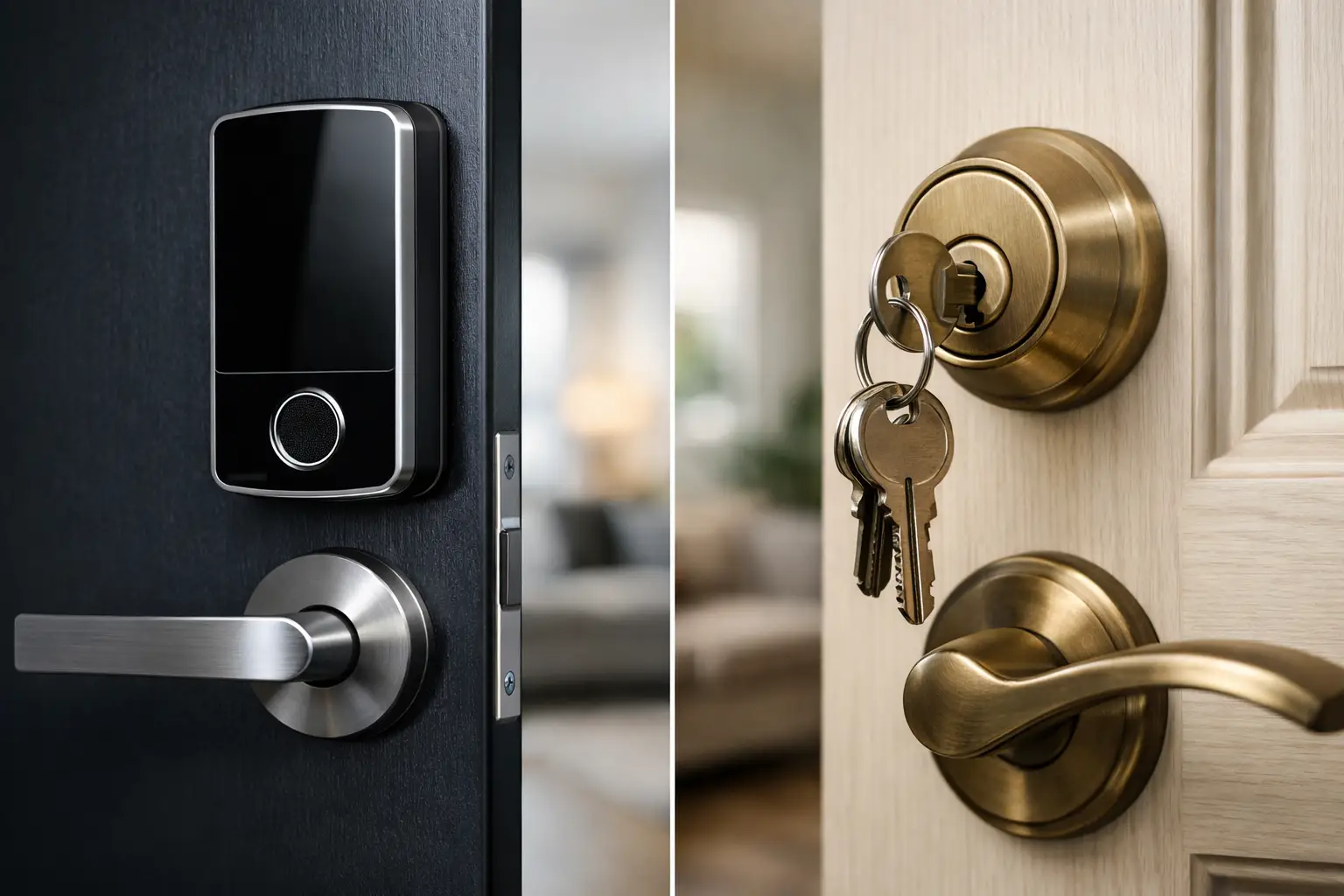
A front door lock has one job: keep the wrong person out while letting the right person in without a problem. When comparing smart locks versus deadbolts, the better choice depends on more than convenience. Your door material, existing hardware, household routine, building rules, and need for emergency access all affect the right answer.
For many South Florida homes, the strongest solution is not an either-or decision. A quality deadbolt remains the physical barrier that protects the door, while smart technology can change how authorized people gain access. The key is choosing hardware that fits the door correctly and having it installed so the lock, strike plate, frame, and door alignment work together.
Smart Locks Versus Deadbolts: The Real Difference
A traditional deadbolt is a mechanical lock. Turning a key from the outside or a thumbturn from inside extends a solid bolt into the door frame. Its security depends on the quality of the lock, the bolt, the strike plate, the screws, and the condition of the door frame.
A smart lock is an electronic locking system that may replace a deadbolt, work as a retrofit over an existing deadbolt, or operate as part of a larger access-control system. Depending on the model, it can be opened with a keypad code, smartphone app, key fob, fingerprint reader, or physical key. Many smart locks also record access activity and allow temporary codes for guests, cleaners, contractors, or tenants.
That distinction matters because a smart lock is not automatically stronger than a standard deadbolt. Some smart locks contain a conventional deadbolt mechanism. Others are primarily convenience devices with less substantial hardware. A well-made mechanical deadbolt can be highly secure, while a poorly installed smart lock can create reliability issues no matter how many features it offers.
When a Traditional Deadbolt Makes More Sense
A traditional deadbolt is often the practical choice for homeowners who want dependable physical security without batteries, apps, Wi-Fi connections, or user-code management. It works during a power outage, requires little ongoing attention, and gives many property owners confidence because its operation is simple and familiar.
For a side door, storage room, garage entry, or rental property where access does not change often, a quality keyed deadbolt may be exactly what is needed. It is also a solid option when a homeowner prefers keys and does not want notifications or remote controls tied to their front door.
Deadbolts are especially effective when the surrounding door hardware is addressed at the same time. A heavy-duty strike plate secured with long screws into the framing can matter as much as the lock itself. If the door is loose, warped, sagging, or misaligned, even an expensive deadbolt may not latch or secure correctly.
The trade-off is key control. Every copied, lost, or unreturned key can become a security concern. After a move, tenant turnover, employee departure, lost key, or attempted break-in, the lock may need to be rekeyed or replaced. That is manageable, but it is not as immediate as deleting a digital access code.
Where Smart Locks Offer a Clear Advantage
Smart locks are most useful when several people need controlled access without passing around physical keys. A family can assign separate codes, a landlord can change a tenant code between leases, and a business owner can remove access for a former employee without collecting every key.
For busy households, the daily benefit is simple: no searching for keys while carrying groceries, managing children, or returning from the beach. A keypad lock can also prevent the common problem of a child losing a house key. Some models automatically lock after a set period, which helps households that occasionally leave the door unsecured.
Smart locks can be a strong fit for vacation homes and rental properties in Broward and Palm Beach Counties. Temporary codes can be set for service providers or arriving guests, then removed when access is no longer needed. Property managers can also see whether a door was locked, depending on the model and settings.
However, smart features require good habits. Use unique codes instead of shared codes, remove old users promptly, enable account security features, and keep the manufacturer app updated. A smart lock should reduce key-control problems, not replace one loose access process with another.
Battery and Connectivity Considerations
Most residential smart locks run on batteries, not household power. Low-battery alerts are helpful, but they only work if someone pays attention to them. Replace batteries on a schedule and keep the correct spares available. Many models provide a physical key override or temporary external power option, but those features vary.
A Wi-Fi outage usually does not stop a keypad from operating locally, though it can prevent remote control and notifications. Before buying, confirm what functions continue without internet service. That is particularly relevant during severe weather, when reliable entry and exit matter most.
South Florida heat, humidity, salt air near the coast, and heavy rain can also be hard on exterior hardware. Select a lock rated for outdoor use, and do not ignore early signs of corrosion, sticking, or inconsistent keypad response.
Security Depends on Installation, Not Just Features
The most common mistake is judging a lock by its packaging alone. A lock can have a respected grade, a keypad, and a polished appearance but still underperform if it is installed on a weak door frame or a damaged door.
The deadbolt bolt should extend fully into the strike opening without forcing the door upward, downward, or inward. The strike plate should sit securely against solid framing. The door should close and latch without rubbing, and the interior thumbturn must be easy to operate for a quick exit.
Avoid placing a keypad or smart deadbolt on a door that already has alignment problems. The motor may struggle to move the bolt, draining batteries and causing intermittent failures. Correct the door and frame issue first, then install the new hardware.
For exterior doors, consider the full opening: lock, hinges, strike plate, door frame, glass near the lock, and any sidelights. A stronger lock alone cannot compensate for a vulnerable entry design. After a break-in attempt, a professional inspection can identify damage that is easy to miss but affects how securely the door closes.
Smart Locks Versus Deadbolts for Rentals and Businesses
Landlords often benefit from smart locks when turnover is frequent and key accountability is a concern. Changing a code between tenants is faster than rekeying each time, provided the lease, local requirements, and emergency access procedures are clear. Still, a physical key override is often wise for maintenance and backup access.
For a small office, retail shop, or professional suite, a consumer smart lock may be suitable for a limited number of users. Once multiple shifts, restricted areas, employee turnover, audit needs, or emergency-exit requirements are involved, a commercial access-control system is usually the better approach. It can manage credentials more consistently and integrate with electric strikes, magnetic locks, buzzer systems, and door hardware designed for commercial use.
Never use an access device in a way that interferes with required emergency egress. Exit doors must allow occupants to leave safely and quickly. Commercial lock and access decisions should account for fire codes, occupancy, door type, and the purpose of the opening.
How to Choose the Right Lock for Your Door
Start with the question that matters most: who needs access, and how often does that change? If the answer is one household with stable key use, a high-quality deadbolt may be the most dependable answer. If you regularly coordinate access for family, staff, tenants, guests, or service providers, a smart lock can save time and improve control.
Then consider your tolerance for maintenance. A traditional deadbolt needs occasional lubrication and key management. A smart lock needs battery checks, code administration, and occasional software updates. Neither option is maintenance-free.
Finally, match the lock to the door and the level of risk. Front doors, rear entries, rental units, storefronts, and restricted business areas have different demands. A locksmith can evaluate whether rekeying, a stronger mechanical deadbolt, a keypad lock, or a commercial access solution makes the most sense for the property.
Access Locksmith & Security can assess the complete door opening, explain the available options in plain language, and install hardware that supports dependable daily use. The best lock is the one that gives you reliable access, clear control over who enters, and confidence that the door is secured when it matters.

