
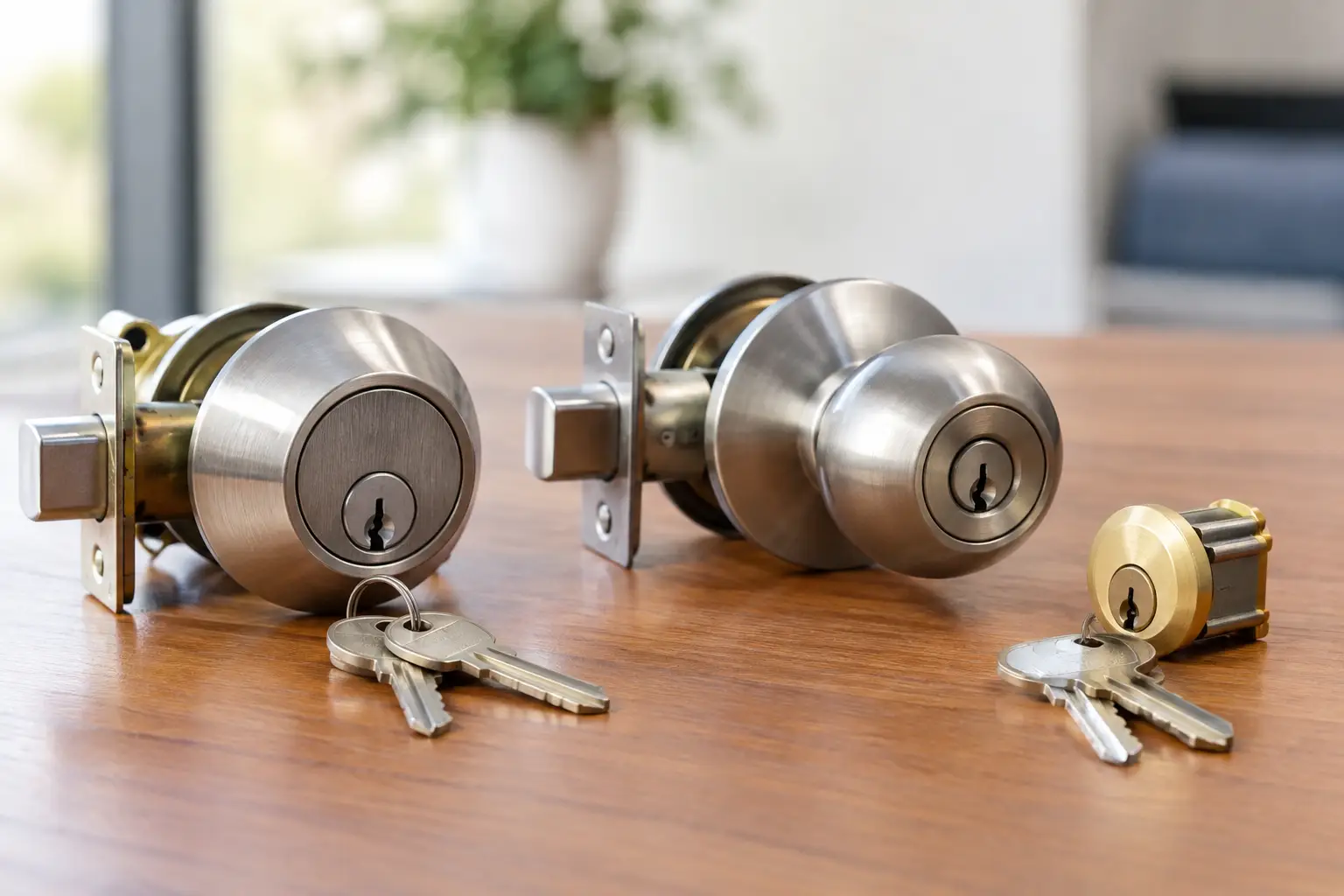
A tenant moves out, a key ring goes missing, or a door starts sticking when you turn the key. The immediate question is usually the same: rekeying versus replacement, which solution actually protects your property without paying for work you do not need?
For many Broward and Palm Beach County homes and businesses, rekeying is the fast, cost-conscious answer after keys change hands. Replacement becomes the better choice when the lock itself is worn, damaged, outdated, or no longer provides the level of protection the door requires. The right decision starts with the condition of the hardware, not just the urgency of the moment.
What Rekeying Changes and What It Does Not
Rekeying changes the internal key pins inside an existing lock cylinder so the old key no longer operates it. The lock stays on the door, but it receives a new key combination. A locksmith disassembles the cylinder, replaces or rearranges the pins, tests the new key, and confirms that the door locks and unlocks properly.
This is not the same as making a duplicate key. Duplicate keys preserve the current key pattern. Rekeying cancels the old pattern altogether, which is why it is useful when you cannot account for every key that may be in circulation.
Rekeying is usually a strong fit when the lock hardware is in good working order but control of the keys has changed. That includes a recent move, a change in roommates, employee turnover, a lost key, or a contractor who no longer needs access. It can also simplify a property with several doors by allowing qualified locks to operate on one new key.
What rekeying does not do is repair a failing lock or strengthen weak hardware. If the latch is loose, the cylinder binds, the deadbolt does not extend fully, or the door frame is damaged, new key pins will not solve the underlying problem. A lock must be functional and compatible with rekeying for this service to make sense.
When Rekeying Is the Smart Security Move
The strongest reason to rekey is uncertainty about who has a working key. You may have collected keys from a previous tenant or employee, but copies can be made without your knowledge. Rekeying gives you a known starting point without automatically replacing every lock in the building.
For landlords and property managers, rekeying between occupants is often faster and more practical than replacing good hardware unit by unit. It helps restore key control while keeping the property’s lock system consistent. A master rekey system may also allow designated managers to access multiple spaces while each tenant or office maintains its own unique key.
Homeowners often choose rekeying after closing on a property. Even when the seller turns over keys, there may have been prior owners, service providers, pet sitters, neighbors, or family members with copies. Changing the key combination is a straightforward way to make the home yours from day one.
Businesses should also consider rekeying after staffing changes, especially where keys open stockrooms, offices, records areas, gates, or equipment rooms. If a former employee’s key is unaccounted for, delaying action can leave a simple and preventable access gap.
Rekeying is generally less expensive than replacing an entire lock because the existing hardware remains in place. But cost should not be the only deciding factor. If the lock shows signs of failure or lacks the features your property now needs, a less expensive fix can become a short-term solution with a second service call later.
Rekeying Versus Replacement: Signs You Need New Locks
Replacement means removing the current lock or lock components and installing new hardware. It is appropriate when the issue is physical condition, security performance, compatibility, or a change in how the door needs to operate.
A lock should be evaluated for replacement when it is difficult to turn, frequently jams, has visible corrosion, has been damaged during a break-in, or cannot reliably lock from either side. South Florida humidity, salt air near the coast, heavy daily use, and exposure to rain can all affect exterior hardware over time. A lock that works only after repeated effort is not dependable security.
Replacement is also worth considering when the current hardware is basic, outdated, or mismatched to the door. For example, an exterior entry may need a stronger deadbolt, a reinforced strike plate, or higher-security key control. A business may need to move from conventional keyed entry to electronic access control, a keypad, an electric strike, or a magnetic lock. Those upgrades require more than a rekey.
After a forced-entry attempt, a locksmith should inspect more than the key cylinder. The bolt, latch, strike plate, screws, door edge, jamb, hinges, and closer can all be affected. Installing a new lock without correcting a split jamb or misaligned door can leave the entry vulnerable and cause the replacement hardware to fail prematurely.
Replacement may also be necessary when locks are incompatible with one another. Not every brand, cylinder, or keyway can be rekeyed to match another door. A professional can explain whether your current hardware can be keyed alike, whether compatible cylinders are available, or whether replacing selected locks will create a cleaner, more manageable system.
A Practical Way to Decide
Start with two questions: Are the keys the problem, or is the lock the problem? If you simply need old keys to stop working and the door hardware operates smoothly, rekeying is often the right first choice. If the hardware is damaged, unreliable, low quality, or inadequate for the opening, replacement is the safer investment.
Next, consider the door’s purpose. A bedroom or interior office may have different needs than a front door, storefront, rear exit, pool gate, or records room. Exterior and high-traffic commercial doors typically demand more durable hardware and closer attention to alignment, latching, and access control.
Finally, think beyond one door. A few unrelated keys may be inconvenient at home, but at a commercial property they can create confusion and weak accountability. A properly planned rekey or replacement project can organize access by employee role, tenant space, department, or building area. For facilities with emergency exits, any changes must preserve safe egress and use appropriate exit hardware.
Why a Lock Inspection Matters Before Choosing
A proper lock decision should include an on-site inspection, particularly after damage or when several doors are involved. The technician should check the condition of the cylinder, bolt, latch, strike, door frame, hinges, and door alignment. They should also ask who needs access, whether old keys may be unaccounted for, and whether you want one key or separate key control for different areas.
This inspection avoids a common mistake: replacing a lock that only needs adjustment, or rekeying a lock that is already near failure. It also identifies doors that may need a door closer, panic device service, electric strike, or a stronger strike plate rather than a standard lock change.
Access Locksmith & Security provides licensed and insured locksmith service for residential and commercial customers throughout Broward and Palm Beach Counties. With more than 19 years of experience, the team can assess whether your existing locks can be safely rekeyed, repaired, or should be replaced, then explain the options clearly before the work begins.
Do Not Wait for a Complete Lock Failure
A key that catches, a deadbolt that requires force, or a door that will not latch consistently is a warning sign. Waiting until the lock fails can leave you locked out, unable to secure the property, or facing an urgent repair at the worst possible time. The same is true after lost keys or a staff departure: key control is easiest to restore before there is a security incident.
If the hardware is sound, rekeying can quickly give you control of access again. If the lock or door assembly is compromised, replacement and targeted repairs provide the more dependable path. A qualified local locksmith can help you make the call based on the door in front of you, so your next turn of the key brings confidence rather than another problem.

