
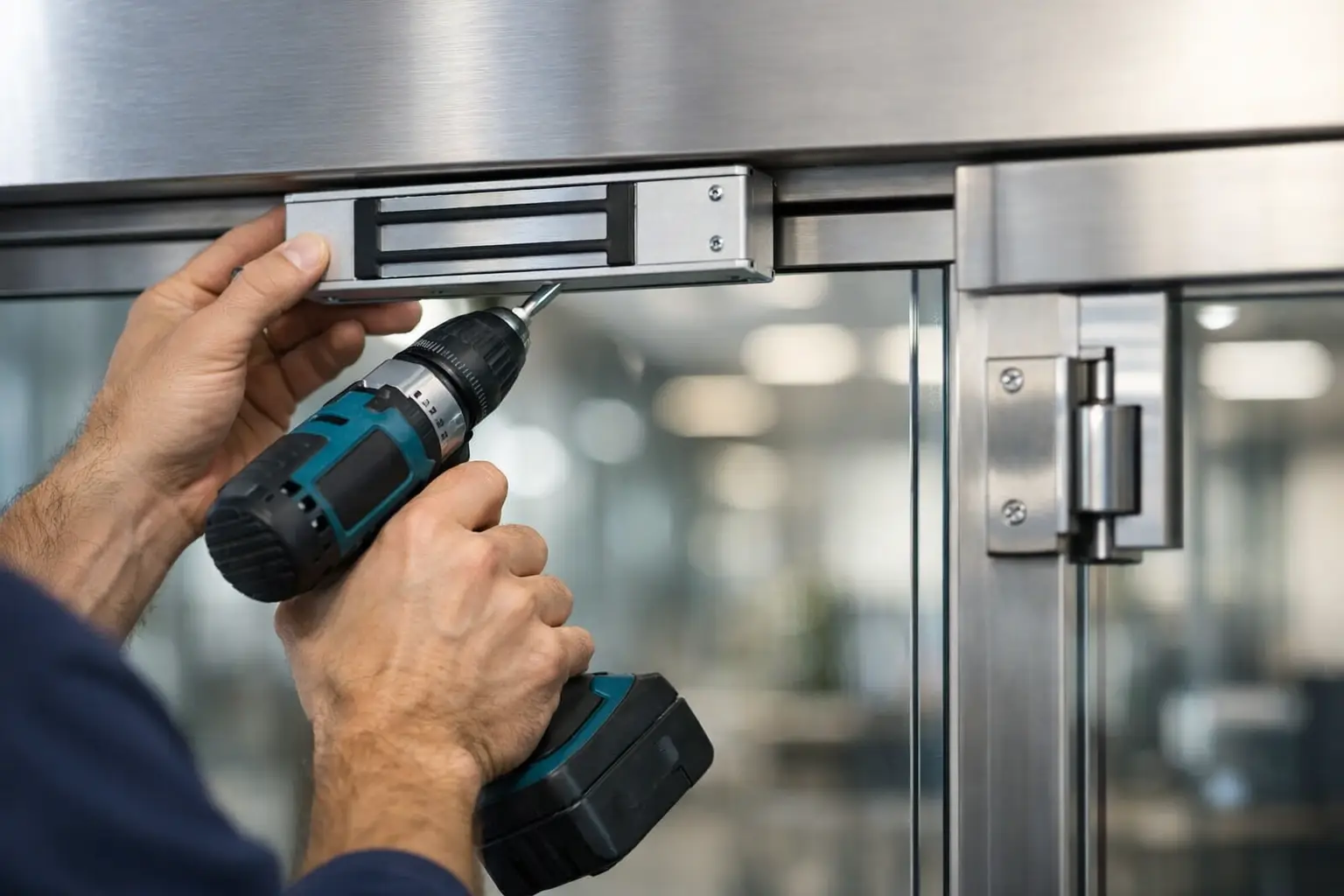
A rear employee door that does not secure properly can create a real problem after business hours. A magnetic lock can provide dependable controlled access, but it must be installed as part of a complete door, power, and life-safety system. When you install magnetic lock door hardware, the goal is not simply to keep a door closed. The system must also allow people to exit safely, operate correctly during an emergency, and hold up to daily use.
For South Florida businesses, property managers, medical offices, schools, warehouses, and multi-tenant properties, a properly planned magnetic lock can strengthen access control without creating unnecessary risk or frustration for occupants.
What a Magnetic Lock Does
A magnetic lock, often called a maglock, uses an electromagnet mounted on the door frame and a metal armature plate mounted on the door. When power reaches the magnet and the door closes, the two components hold together with substantial force. Access is then controlled through a credential reader, keypad, buzzer, intercom, push button, or access-control system.
Most magnetic locks are fail-safe. That means the lock releases when power is removed. This is a major reason maglocks are common on controlled-entry doors, but it is also why power planning and emergency-release devices matter. A power interruption, fire alarm activation, or properly configured emergency release can cause the door to release.
Maglocks work especially well on commercial glass aluminum doors, metal doors, office entry doors, secured interior doors, and certain gate applications. They are not automatically the right answer for every opening. A storefront with high traffic, a fire-rated door, an exterior door exposed to wind and rain, or a door that already has panic hardware may need a different locking method or additional hardware.
Before You Install a Magnetic Lock Door System
The door itself determines much of the project. A magnetic lock needs a solid mounting surface, proper door alignment, and a door closer that allows the door to close fully every time. If the door drags, slams, has loose hinges, or does not latch consistently, installing the maglock first can lead to repeat service calls and unreliable security.
The opening should also be evaluated for safe exit. A locked entry door is only one part of the equation. People inside the building need a clear, code-appropriate way to leave without special knowledge, keys, credentials, or complicated steps. Depending on the property and local requirements, that can involve a request-to-exit motion sensor, a push-to-exit button, a dedicated emergency-release station, a fire alarm interface, or panic hardware.
Requirements can differ based on occupancy type, door location, fire rating, local code enforcement, and the authority having jurisdiction. A medical office, child-care facility, retail store, apartment common area, and warehouse may not have identical needs. This is where professional evaluation protects both the property owner and the people using the building.
Before work begins, confirm these practical details:
- The door and frame are in good condition and close correctly.
- The power supply has enough capacity for the lock and connected equipment.
- Exit hardware and emergency release methods are suitable for the opening.
- Cable routes can be protected and kept out of sight where possible.
- The access method matches how the property operates, whether that is cards, fobs, a keypad, an intercom, or a front-desk release button.
How Professionals Install Magnetic Lock Door Hardware
A proper installation begins with measuring the frame, door style, and available mounting area. Standard top-of-door maglocks are common, but glass doors, narrow frames, outswing doors, and unusual openings may require brackets such as L brackets, Z brackets, or specialized glass-door mounting hardware. Using the wrong bracket can reduce holding performance or prevent the door from closing properly.
The electromagnet is then mounted securely on the frame, while the armature plate is mounted on the door with the correct hardware and movement. The armature is designed to sit flat against the magnet when the door closes. If it is mounted too tightly, crooked, or too far from the magnet, the lock may not achieve its intended holding force.
Next comes the wiring. Low-voltage cable is routed from the power supply to the lock and any control devices. A professional installer considers more than whether the lock powers on. The wiring must be protected from damage, labeled for future service, and integrated correctly with the access-control panel, reader, exit device, and fire alarm connection when required.
The power supply is another area where shortcuts cause problems. Magnetic locks draw power continuously while secured, so the supply must be sized for the lock, access-control components, future expansion, and any backup battery requirements. A marginal power supply may work at first but create intermittent releases, reader failures, or trouble when additional equipment is added later.
For a system with card access, keypad entry, or remote release, the installer programs the control method after the physical hardware is in place. This may include setting door-release times, user credentials, schedules, and monitoring features. A short release time may frustrate customers carrying packages or employees moving equipment. A long release time can reduce security. The right setting depends on traffic flow and the purpose of the opening.
Safe Egress Is Part of the Installation
Security should never leave occupants guessing how to exit. A magnetic lock installation must be planned around the door’s egress requirements, not added as an afterthought. This is particularly relevant for public-facing businesses, offices with staff, residential common areas, and facilities that may be occupied after hours.
A request-to-exit sensor can release the lock when it detects someone approaching the door from the inside. In many applications, a push-to-exit button or emergency-release device provides another direct release method. Where required, the system may also need to release when the fire alarm activates or when power is lost.
These components must be placed where users can reach and understand them. They also need to be tested under real conditions. For example, a motion sensor positioned too far from the door can release it before a person reaches the opening, while one aimed poorly may fail to detect someone standing near the exit.
Testing a New Magnetic Lock
Once the hardware and controls are installed, testing should cover normal entry, authorized access, free exit, emergency release, door closure, and power-loss behavior. The installer should confirm that the armature contacts the magnet evenly, the closer shuts the door fully, and the lock re-secures as expected after each use.
Testing should also include the practical details people notice every day. Does the reader respond consistently? Does the buzzer release the correct door? Can a visitor hear the intercom? Does the door release long enough for someone with a cart, wheelchair, or delivery package? Small adjustments at this stage can prevent daily operational headaches.
Common Problems After Installation
A maglock that hums, releases randomly, or will not hold may have a power, alignment, wiring, door-closer, or bracket issue. In coastal Broward and Palm Beach County locations, corrosion and moisture exposure can also affect exterior hardware and connections over time. Regular inspection is especially worthwhile for doors near parking areas, pools, loading zones, and exterior walkways.
Another common issue is treating the magnetic lock as a stand-alone device when it is actually part of an access-control system. A failed credential reader, weak backup battery, damaged exit button, or misconfigured control board can affect the door even when the magnet itself is functioning correctly. Qualified troubleshooting identifies the source before parts are replaced unnecessarily.
Choose the Right Security Partner for the Door
Installing a magnetic lock can be a smart improvement for access control, but the installation is only as reliable as the door condition, wiring, egress planning, and system configuration behind it. Access Locksmith & Security evaluates the complete opening so businesses and property managers can make decisions with clear expectations, proper workmanship, and dependable service.
If a door needs controlled access, start with the opening, the people who use it, and the way they must exit during an emergency. That approach helps create security that supports your property without compromising daily operations or peace of mind.

