
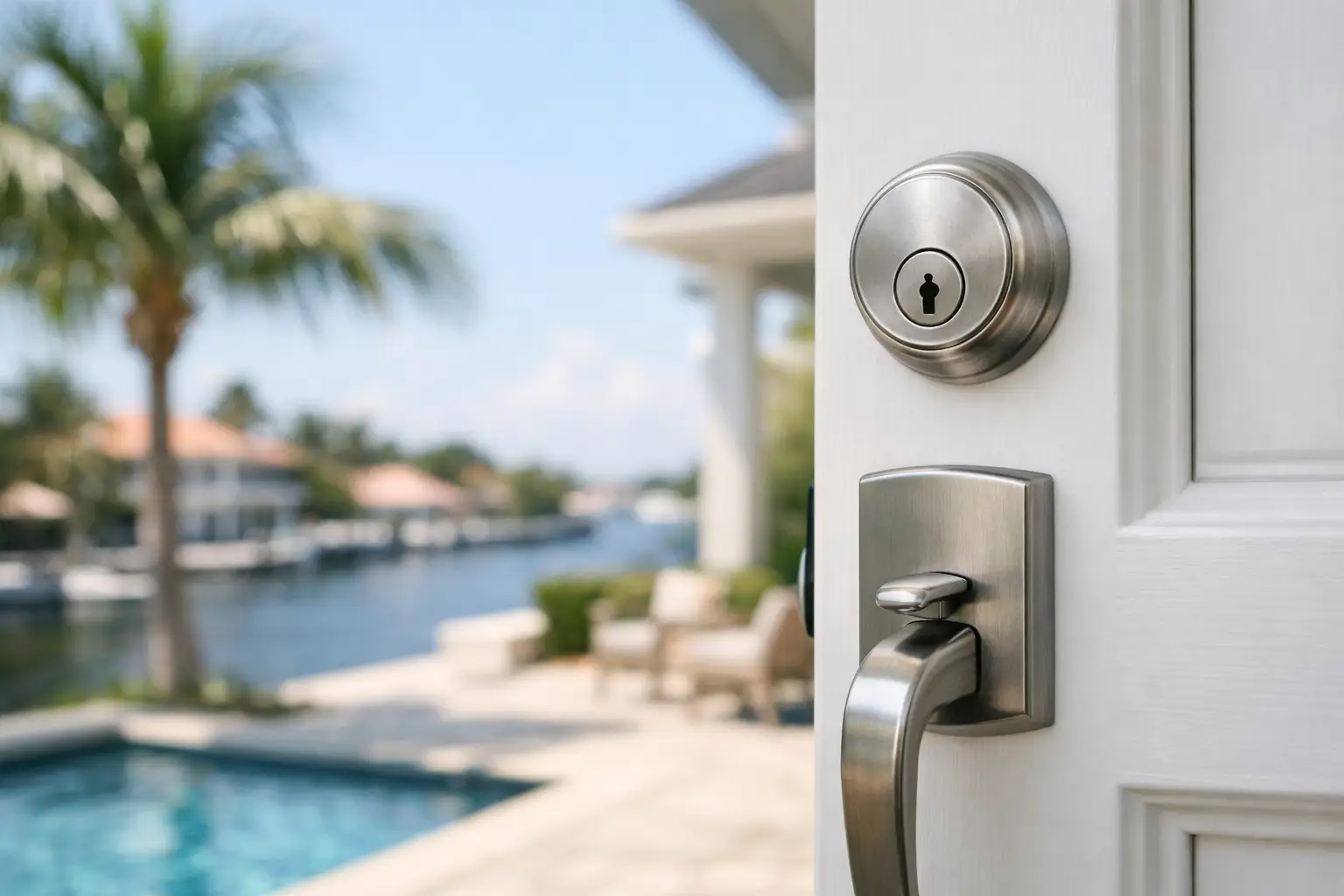
A deadbolt is only as effective as the door, frame, and installation behind it. In Broward and Palm Beach Counties, the best residential deadbolts are the ones that fit your specific entry door, resist common forced-entry attempts, and continue operating reliably through heat, humidity, and daily use.
A well-chosen deadbolt gives your household a strong first line of defense. A poorly matched or loosely installed lock can create a false sense of security, even when the hardware itself looks substantial. Before choosing a new lock, focus on lock grade, door condition, strike reinforcement, key control, and whether a traditional or electronic option actually fits how your household enters the home.
1. ANSI Grade 1 Deadbolts for Maximum Security
For homeowners who want the strongest commonly available residential option, an ANSI Grade 1 deadbolt is usually the right starting point. ANSI/BHMA grades measure how a lock performs under testing for strength, durability, and resistance to forced entry. Grade 1 is the highest rating, followed by Grade 2 and Grade 3.
Grade 1 deadbolts are a smart choice for front doors, doors leading from a garage into the home, side entrances, and any exterior door with frequent use. They are particularly valuable where the entry is visible from the street or where a homeowner wants a higher level of physical protection without moving to commercial hardware.
The trade-off is cost. Grade 1 hardware typically costs more than a basic deadbolt, but it is a meaningful investment when paired with a reinforced strike plate and solid door frame. For many homes, a Grade 2 deadbolt can still be appropriate for a less-used secondary door, provided the door and frame are in good condition.
2. Single-Cylinder Deadbolts for Most Exterior Doors
A single-cylinder deadbolt has a key cylinder on the outside and a thumbturn on the inside. For most residential doors, this is the practical standard. It allows a person inside the home to exit quickly without searching for a key, which matters during an emergency.
Single-cylinder models work well on front, side, back, and garage-entry doors that do not have glass close enough to the inside thumbturn. They are simple to use, easy to rekey, and available in Grade 1 and Grade 2 options from established lock manufacturers.
The quality of the installation matters as much as the cylinder. A deadbolt should extend fully into the frame, and the strike plate should be secured with long screws that reach into the wall framing rather than only the decorative trim. This is where a professional lock installation can make a major difference.
3. Double-Cylinder Deadbolts for Glass-Adjacent Doors
A double-cylinder deadbolt requires a key from both the outside and inside. It can be useful on doors with glass panels or nearby sidelights, where someone could potentially break glass and reach the interior thumbturn.
However, this option requires careful consideration. A key-required interior lock can slow emergency exit if the key is not immediately available. Some local building codes, homeowner association rules, insurance requirements, and fire-safety considerations may limit where double-cylinder locks are appropriate.
If you are considering one, do not make the decision based on security alone. A locksmith can inspect the door layout and recommend a safer approach, such as reinforced glass, a different lock location, or an alternative door-security upgrade. Keep an interior key accessible only to responsible occupants and never leave it inserted in the lock where it can be reached through broken glass.
4. High-Security Keyway Deadbolts for Better Key Control
Standard residential locks are convenient, but common keyways can be easier to duplicate without the property owner knowing. A high-security deadbolt with a restricted or controlled keyway gives homeowners more control over who can obtain copies of their keys.
This is especially useful after a move, divorce, roommate change, tenant turnover, contractor access, or lost keys. It can also be a strong choice for landlords and property managers who need a more consistent key-control plan across several homes or units.
High-security cylinders may offer additional resistance to picking, bumping, and drilling, depending on the model. Still, no lock should be judged by one feature alone. The cylinder, bolt, strike, door material, hinges, and installation all need to work together. A high-security keyway on a weak door frame will not solve the entire problem.
5. Smart Deadbolts for Keyless Convenience
Smart deadbolts can be an excellent fit for homeowners who want keyless access, individual user codes, automatic locking, or the ability to remove access without collecting physical keys. They are popular for busy households, vacation properties, rental homes, and owners who regularly provide access to cleaners, caregivers, or family members.
The best smart deadbolt for your home is not always the model with the most app features. Start with the mechanical basics: a respected lock grade, a properly aligned door, a strong bolt, and a reliable backup entry method. Batteries should be easy to replace, and you should understand what happens if the battery is low, the internet is down, or the keypad fails.
For a primary residence, choose a smart lock that lets you create separate codes instead of sharing one code with everyone. Delete temporary codes as soon as they are no longer needed. If the lock connects to a home network, change default account credentials and keep its software current.
6. Keypad Deadbolts for Simple Code Access
Not every household needs a connected smart lock. A keypad deadbolt without remote app control can provide much of the convenience of keyless entry while keeping operation simple. These locks are often a good match for families with school-age children, older adults who prefer not to carry keys, or homeowners who want access codes without relying on Wi-Fi.
A keypad deadbolt should still have a reliable mechanical key override or another approved backup method. Avoid placing a spare key in obvious hiding spots around the property. If a key is lost or an unknown person may have had access to it, rekeying or replacing the cylinder is more secure than hoping the key never turns up.
7. Reinforced Deadbolt Systems for Older Doors and Frames
Sometimes the best upgrade is not a new deadbolt alone. Older South Florida homes may have worn wood frames, short strike screws, loose hinges, misaligned doors, or weather-related swelling that prevents the bolt from extending correctly. These problems can cause a quality lock to bind, fail prematurely, or provide less resistance during a forced-entry attempt.
A reinforced deadbolt system may include a heavy-duty strike plate, longer structural screws, door-jamb reinforcement, hinge upgrades, and correction of door alignment. For doors that have been kicked, pried, or damaged during a prior lockout or break-in, repair the frame before relying on a new lock.
This approach is often more valuable than simply buying the most expensive lock on the shelf. Physical security is a system. The lock is one part of it.
How to Choose Between the Best Residential Deadbolts
Start by identifying the door’s role. Your main entry deserves the highest level of protection and durability your budget allows. A rear door that is rarely used may need the same strength if it is secluded or poorly visible from neighboring homes. A door from an attached garage into the home should not be treated as an afterthought.
Next, inspect the door itself. Solid wood, metal, and fiberglass doors are generally better candidates for a quality deadbolt than hollow-core doors. Check whether the deadbolt latches smoothly without lifting, pushing, or pulling the door. If it does not, the alignment needs attention before a new lock is installed.
Then consider who needs access. A traditional keyed deadbolt may be the right fit for a household that values simplicity. A controlled keyway provides stronger key management. A keypad or smart deadbolt can make access easier for family members and approved visitors, but it adds batteries, programming, and occasional troubleshooting to the equation.
Finally, do not ignore rekeying. If you have recently purchased a home or do not know who has copies of the existing keys, rekeying should be part of the lock upgrade. It is one of the fastest ways to restore control of your home’s access.
Professional Installation Protects the Investment
Deadbolt installation looks straightforward until the bolt misses the strike by a fraction of an inch, the door edge splits, or the cylinder is installed incorrectly. Proper sizing, alignment, drilling, and frame reinforcement help the lock operate as designed and help avoid damage to the door.
Access Locksmith & Security can assess your existing door hardware, recommend an appropriate residential deadbolt, rekey compatible locks, and install the hardware with attention to the entire entry point. For homeowners facing a broken lock, lost keys, attempted break-in, or urgent security concern, timely service helps restore control quickly.
Your front door should close cleanly, lock securely, and give you confidence each time the last person leaves the house. If your deadbolt sticks, spins, has a loose strike plate, or uses keys you cannot account for, it is worth addressing before a small issue becomes a security problem.

