
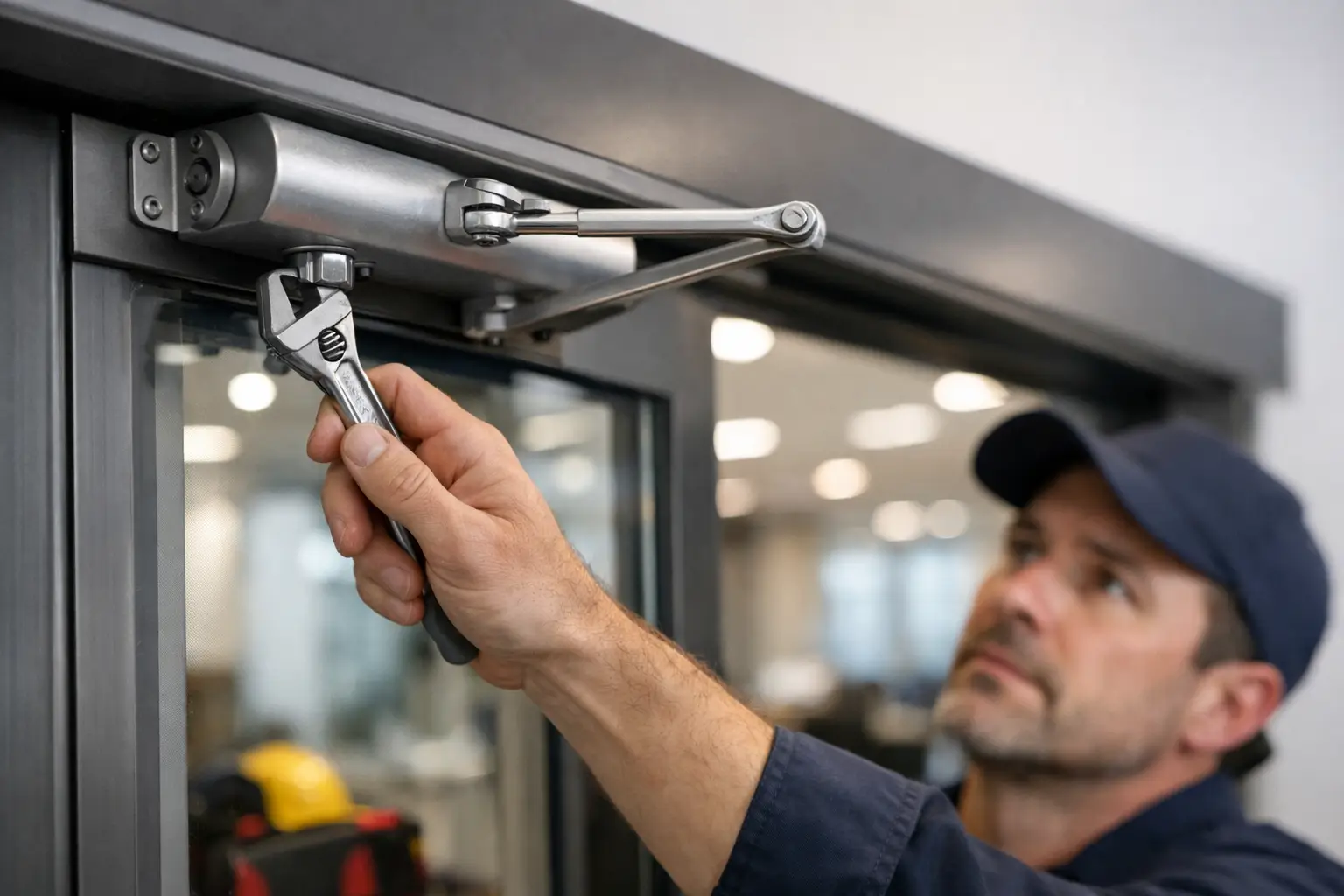
A commercial door that slams hard, will not latch, or drifts open is more than an everyday annoyance. It can interrupt business, damage frames and locks, create accessibility concerns, and weaken the security of your property. Prompt commercial door closer repair restores controlled closing and helps protect the people, equipment, and inventory inside your building.
For businesses, medical offices, retail stores, schools, warehouses, apartment communities, and managed properties across Broward and Palm Beach Counties, a door closer has a serious job. It must close the door reliably after every use while allowing people to enter and exit safely. When that mechanism fails, the problem can quickly become a safety, security, or compliance issue.
What a Commercial Door Closer Does
A door closer is the hydraulic or spring-loaded device mounted at the top of a door, on the frame, or concealed within the door and frame. It controls how the door moves after someone opens it. Most commercial closers manage three basic actions: the sweep speed as the door moves toward closed, the latch speed in the final few inches, and the closing force needed to overcome weatherstripping, air pressure, and latch resistance.
A properly adjusted closer should feel controlled rather than heavy. The door should close fully, latch securely, and avoid slamming. It should also work with the rest of the opening, including hinges, pivots, panic hardware, electric strikes, magnetic locks, access control readers, and weather seals.
That last point matters. A closer may appear to be the problem when the real issue is a misaligned strike, sagging hinges, a warped door, or hardware installed with the wrong tension. Effective repair starts with diagnosing the entire opening, not simply turning adjustment screws.
Signs You Need Commercial Door Closer Repair
Door closer failures often develop gradually. Staff may get used to pulling a door shut or giving it an extra push until the day the door stays open after closing time. Calling for service at the first signs of trouble can prevent damage to the lock, frame, glass, or access-control components.
Watch for these common warning signs:
- The door slams shut loudly or closes with excessive force.
- The door closes too slowly, stops before latching, or remains partly open.
- Oil is leaking from the closer body or arm assembly.
- The door is difficult to open, especially for customers, tenants, or employees.
- The closer arm is loose, bent, rubbing, or pulling away from the door or frame.
- The door closes correctly at some times but fails when air conditioning, wind, or pressure changes occur.
- The door drags on the floor, scrapes the frame, or no longer aligns with the latch.
A leaking closer is usually a clear indication that replacement is needed. The hydraulic fluid is what allows the unit to control the door’s movement. Once the internal seal fails, adjusting the unit may offer only a temporary improvement, if any.
Repair or Replace? The Right Answer Depends on the Failure
Not every closer problem requires a new unit. If the closer is in good condition but has been adjusted incorrectly, a trained technician may be able to reset the sweep speed, latch speed, and closing force. Loose mounting screws, a shifted arm, or minor alignment issues can also be repaired without replacing the closer.
Replacement is often the smarter option when the closer leaks, the internal mechanism is worn out, the body is cracked, the arm is bent beyond safe repair, or the current closer is undersized for the door. A heavy glass storefront door, solid-core metal door, or exterior entry may need a different closer than an interior office door. Installing a closer that is too weak can lead to recurring latch failures. Installing one that is too strong can make the door difficult to open and create avoidable accessibility concerns.
The correct choice also depends on the door’s role. A high-traffic front entrance may justify a durable commercial-grade closer designed for frequent cycles. A rear employee entrance may need coordinated hardware that works with an electric strike, access control, or a panic exit device. For fire-rated doors, the closer must allow the door to self-close and positively latch as intended. Propping that door open or using an unsuitable closer can create a serious life-safety concern.
Why Adjustment Screws Are Not a DIY Fix
Many door closers have visible adjustment valves, which can make the repair look simple. In reality, small changes can significantly affect performance. Turning the wrong valve too far may cause the door to slam, stop closing, or leak hydraulic fluid. Removing a valve entirely can release fluid and permanently damage the unit.
There is also a reason the closer may have fallen out of adjustment. A door that no longer latches may have worn hinges, a damaged strike plate, a loose frame, or an improperly installed weatherstrip. Adjusting the closer to force the door shut can place extra stress on the hardware and hide the underlying problem.
For an occupied commercial property, it is usually better to have a qualified technician inspect the door, closer, hinges, latch, and frame together. This approach protects the opening and reduces repeat service calls.
How Professional Commercial Door Closer Repair Works
A proper service visit begins with observing how the door opens, swings, closes, and latches. The technician checks for leaks, damaged arms, loose fasteners, worn pivots or hinges, door sag, latch alignment, and interference from thresholds or weather seals. On access-controlled doors, they also confirm that the closer works correctly with electric locking hardware and does not interfere with safe egress.
If adjustment is appropriate, the closer is set gradually and tested through repeated open-and-close cycles. The goal is not simply to slow the door down. The goal is reliable closing, secure latching, and safe operation for people using the entrance every day.
If replacement is necessary, the closer should be selected based on door weight, width, material, traffic level, mounting style, and building requirements. The mounting surface must be secure, and the arm must be installed at the correct geometry. A quality installation includes final adjustment and testing, not just attaching a new closer to the door.
Door Closers and Security Work Together
A closer is a key part of your building’s physical security. Even the best commercial lock cannot protect a door that does not fully close and latch. On a storefront, side entrance, office suite, or common-area door, a weak closer may leave a gap that compromises the lock or allows unauthorized access.
This is especially important for doors with electric strikes, magnetic locks, keyless entry systems, and panic hardware. These systems need the door to return to the correct closed position every time. If the closer is weak, misadjusted, or damaged, card readers and electric locks may appear unreliable when the actual issue is mechanical.
For property managers, a failing closer can also lead to tenant complaints, damaged doors, higher maintenance costs, and after-hours lockout risks. Addressing the issue early is usually less expensive than repairing a broken glass panel, bent frame, damaged panic bar, or failed access-control component later.
When to Request Urgent Service
Some door closer issues can wait for a scheduled repair, but others need immediate attention. Request prompt professional service if an exterior door will not latch, a fire-rated door will not close, a door slams hard enough to create injury risk, or an exit door is difficult to operate. The same applies when a closer failure leaves your business unable to secure the building after hours.
Access Locksmith & Security provides commercial door hardware service with the experience to assess the closer and the connected locking or access-control hardware. With more than 19 years of industry experience, licensed and insured service, and 24/7 emergency availability, the focus is on getting your door operating safely and securely with clear communication throughout the process.
Do not wait for a door problem to become a security incident or a disruption to your operation. If a commercial door is slamming, sticking, leaking, or failing to latch, have it inspected before the next busy shift, closing time, or emergency creates a bigger problem.

